Increased Sales to Institutions by New England Food Distributors Can Grow the Agricultural Economy
This article was written for the Vermont Farm to Plate Network, available here.
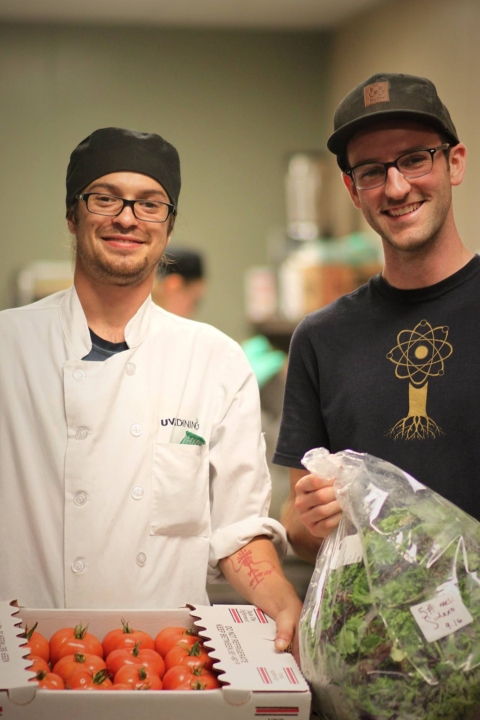
Photo at left: Nick Rucci from the Intervale Food Hub (right) in Vermont provides local food to a Sodexo chef at the University of Vermont. Credit: Intervale Food Hub
New England food distributors play a significant role in how people eat both in and outside of institutional dining facilities and have a strong interest in local food, according to “Getting It There: Understanding the Role of New England Food Distributors in Providing Local Food to Institutions” – a new report by Farm to Institution New England.
The report includes results of a 2015 survey of 56 food distributors in New England who moved over a billion dollars’ worth of food in 2014 and sold an estimated $59 million of local food to institutions. Survey respondents have an overwhelmingly positive outlook on future sales of local products to institutions, suggesting that institutions will continue to grow and strengthen their farm to institution strategies in the coming years.
However, distributors still face significant barriers to meeting the growing institutional demand for local food and reported several key challenges and barriers to selling local products to institutions, including the lack of consistent, year-round supply of local products and the high price point of local products for their customers.
The report contains data-based recommendations for food distributors, government agency staff and elected officials, funders and nonprofits, and institutions to grow this market in a way that benefits the region’s farmers and institutional consumers alike.
20 tips to unlock the power of farm to institution to transform our food system:
For food distributors:
- Promote local food options to nearby schools, colleges, hospitals, and other institutions
- Invest in local food logistics, tracking, and marketing systems
- Cultivate multi-year contracts and seasonal buying commitments
- Gather information about what institutions require in terms of food packing, invoicing, and certifications
For government agencies and elected officials:
- Prioritize farm to institution elements of state food plans
- Create farm to institution working groups in state food policy councils
- Allocate grant funding to projects that support local food and nutrition education at institutions
- Set percentage goals for local and regional food purchasing
For funders:
- Support innovation in local food purchasing at institutions
- Fund additional research on the economic feasibility of institutional markets for food producers
- Help distributors expand to serve institutional markets
- Fund more training and professional development for food service staff to enable cooking from scratch
For nonprofits:
- Promote innovation in local food purchasing at institutions
- Promote training and technical assistance for institutions to effectively develop and use contracts with producers to support more local procurement
- Help producers get “wholesale ready” so they can sell to institutions
- Connect retiring producers with new producers to keep farmland in production and increase the amount of local food being produced
For institutions:
- Ask your distributor how they define “local” or “native” and let them know how you want to define “local”
- Track your local food purchases
- Work with small distributors like food hubs, as they carry a much higher percentage of local foods than larger distributors
- Include local food purchasing goals and values in RFPs and contracts with distributors
To access the full set of recommendations, visit www.farmtoinstitution.org/distributor-report and download the distributor survey report.
The results of our ongoing research are available online at dashboard.farmtoinstitution.org.