TRACKING LOCAL FOOD PURCHASING:
A GUIDEBOOK FOR CAMPUS DINING
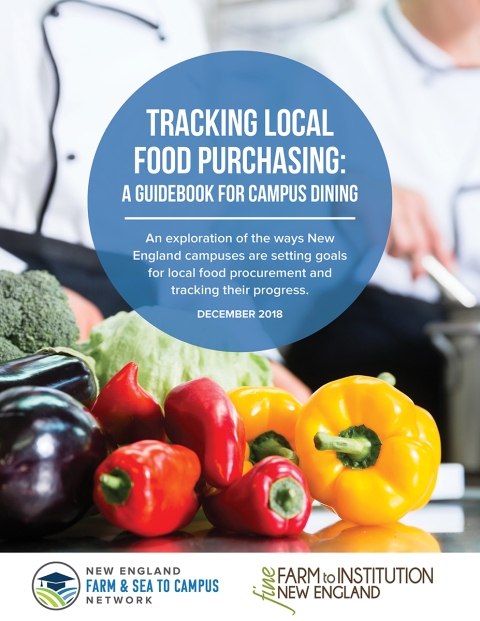
Farm to Institution New England (FINE) is pleased to announce a the release of a new report, “Tracking Local Food Purchasing: A Guidebook for Campus Dining." This report provides colleges and universities with a framework for understanding how tracking systems can benefit their dining operations and local and other food procurement goals. The report highlights challenges campuses encounter in their efforts to track local food purchases, describes a number of common tools, and provides specific recommendations that institutions can implement to help them improve their tracking efforts.
We hope this report will raise important questions and bring the campus community closer to developing promising practices and integrating them into standard dining operations across the New England region – and beyond!
About the Survey
To better understand the role of tracking systems in institutional food procurement strategies, FINE and the New England Farm & Sea to Campus Network conducted a pilot study which consisted of detailed interviews with ten campuses in New England. Campuses in the study were carefully chosen to ensure diversity based on key characteristics. For example, the campuses range from small (500-600 students) to large (up to 28,000 students), include at least one campus from each of the six New England states, and include both self-operated and contracted dining services.
The experiences of these ten campuses may not be representative of the experiences of other campuses in New England; however, the purpose of this report is to describe how some campuses are currently tracking food purchasing data in order to give other campuses in the region a framework for starting or improving their own tracking efforts.
The Importance of Tracking Local Food Procurement
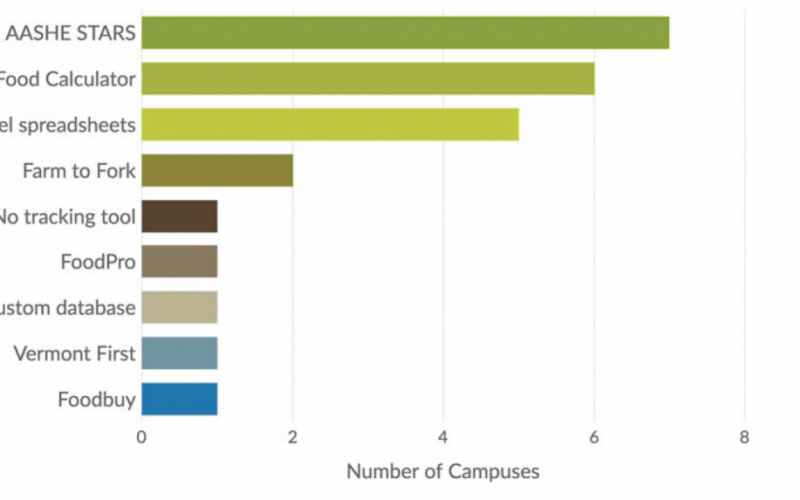
This report builds on quantitative research on local food procurement at college campuses conducted by the FINE metrics team and summarized in the report “Campus Dining 101: Benchmark Study of Farm to College in New England” (click on the link for more information and to access the full report). From past research, we know that an increasing number of campuses have committed to local food procurement goals, and tracking local food procurement is essential to measuring and reporting on progress towards these goals. However, even campuses with local food procurement goals often do not – or are unable to –adequately track progress towards their goals. When asked how they track local purchases, 35 percent of respondents did not report using a tracking tool. We wanted to know why, in spite of strong commitments, so many campuses find it so challenging to track and measure local food procurement.
What is Local?
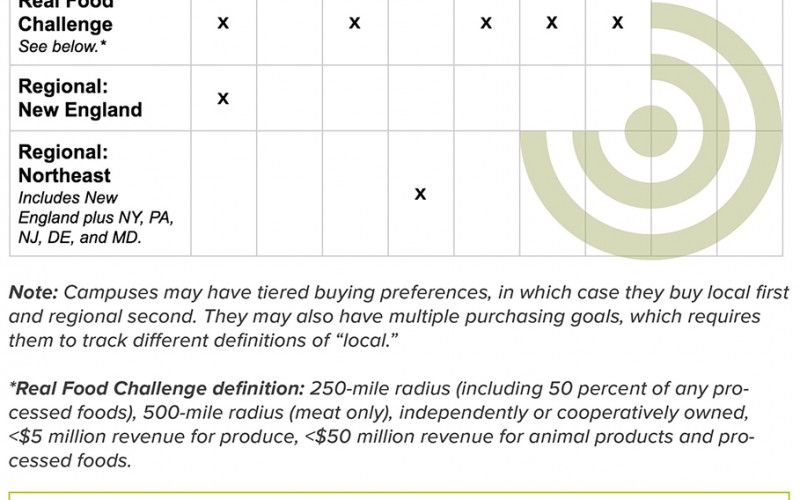
There is currently no agreed upon definition of what “local” food means. Real Food Challenge defines it as “within a 250 mile radius” (along with other stipulations), and this was the most commonly used definition among study participants. Other definitions included “within the state” and “within New England”. Institutions may also define “local” food differently than the food service management company and/or distributors that they use, making it difficult to gather information from the supply chain actors. Adding processed and prepared food items creates additional complexities; for example, if potato chips contain potatoes from Maine but the other ingredients come from across the country, do those chips meet the definition of “local”?
Table 1. Definitions of Local Food
Additional Challenges
Institutional food procurement relies on a complex flow of information and products between a variety of different supply chain actors. They work with various foodservice management companies, distributors, local farms, and other vendors to procure and deliver food to the campus. Each of these supply chain actors may track different sets of information for each food item. They may also use different software or other tracking systems, and share the information with campuses in different forms (e.g., spreadsheets, PDFs). As a result, important information that would allow the campus to assess whether or not a product meets their definitions of “local” may be difficult to acquire, may not get reported the same way, and requires significant staff effort to assess against the unique food values of the campus.
Figure 1. Distribution of Tracking Systems Used by Interviewees
Finding Solutions
Despite the various challenges, many of the campuses we studied are finding manageable ways to track their local food procurement. From working with vendors on data collection, to building expectations into food service management contracts, to investing staff time on data management, campuses are steadily improving their tracking efforts. New technologies and a push for supply chain transparency may provide additional support in solving on-going challenges.
The New England Farm & Sea to Campus Network continues to work on solutions to procurement tracking and other supply chain challenges. If you would like to learn more, or participate in this project, we’d love to hear from you! Share your ideas with us in the comments below, and connect with us at campus@farmtoinst.org.
Full Report
To dive deeper into this analysis of FINE's Tracking Local Food Purchasing: A Guidebook for Campus Dining, download our full report:
You can also read the Tracking Local Food Purchasing report right here:
Webinar Recording
“How to Optimize Local Food Tracking Systems to Meet Procurement Goals” Webinar
Recorded on October 15, 2018
Tracking Local Fact Sheet
In February 2018, FINE released a companion fact sheet that highlights key findings, good ideas, and potential snags from our 2017 researach.
Join the Discussion
Want to get connected and support farm to institution efforts? Here are a few ways to do so:
- Website: Browse www.farmtoinstitution.org to get the latest news and learn more.
- Newsletter: Sign up to receive our email newsletter and browse past editions at www.farmtoinstitution.org/newsletter.
- Social Media: Follow us on Facebook, Twitter, Instagram, LinkedIn, Flickr and YouTube.
- Conference: Save the date for our New England Farm to Institution Summit on April 2-4, 2018 at UMass Amherst.
Header photo courtesy of UMass Amherst