Farming and Zoom-ing don't always go together, but this year, the Northeast Organic Farming Association (NOFA) pulled it off. The first-ever virtual NOFA Summer Conference came to a close earlier this month and FINE is pleased to have been included in the lineup of great presenters! The 2020 conference was held over three weeks from July 20 – August 9, 2020, and featured nearly 60 sessions. FINE led Farm to Institution 101 which culminated in a panel discussion about the value of institutional markets, how farm to institution activity can help create a more resilient and just food system, and the impacts of COVID-19 on these supply chains.
The FTI 101 panel included stakeholders working across the supply chain including Tina White from Real Food Challenge, Andy Cox from Smith College Dining Services, Nick Martinelli from Marty’s Local, and Mike Mahar from Poplar Hill Farm. We were excited to be joined by a group of attendees whose interest in farm to institution ran the gamut from food service managers looking to work more closely with their food service management companies, to farmers, to community members interested in getting more local food into their family member’s nursing home. Recordings from all of the sessions are available to purchase until September 15th.
The insight and perspective shared in this session have never been more timely. Farm to institution activity is changing rapidly in the face of the COVID-19 pandemic. Farmers, distributors, and foodservice directors have had to pivot several times over the last few months in order to feed their constituents and keep their own businesses running. Many institutions (especially colleges and K-12 schools) are making big decisions right now about what their fall plans will look like and how those decisions will impact their dining programs. With that in mind, we have heard from a number of institutions that their previously established relationships with local producers have allowed them to adapt quickly during the pandemic, making them more resilient when others were facing shortages. Read on for the experiences and wisdom of our panelists.
Tips From the Panel
Focus Not Just on the Food, but on Shared Values and Strong Relationships
Values-based procurement can serve as a powerful lever for change in our food system. Our panelists shared specific ways they are contributing to a more just, equitable, and sustainable regional food system. Panelist Nick Martinelli of Marty’s Local noted the importance of personal relationships his business develops with farmers. “There is a human element that connects with the business aspect,” he stated. Marty’s Local staff personally know almost all the farmers they buy from. They make sure that they start with a price that is fair to the farmer and not driven from the “top” of the supply chain down.
“Every dollar that Smith spends in our community has a greater impact than the dollar alone, says Andy. "When we take the time to reward farmers for taking care of the land in our backyard, the whole valley can thrive.”
Work with Local Processors to Establish a Timeline and Processed Product that Saves Everyone Money
Instead of exclusively purchasing select cuts of meat, Smith College purchases whole animals from Poplar Hill Farm in order to make local, antibiotic-and-hormone-free beef purchases economically feasible. Through a collaboration with Westfield State University, Amherst College, Mount Holyoke College, and Hotchkiss School, Smith works with Adams Farm to process the whole animals during specific times of the year when Adams is less busy and can provide services at a lower cost. The institutions also collaborated with each other and with Adams to plan the processed cuts, work out storage and distribution, and adapt menus and recipes. In 2018, they committed to processing 100 steers and 300 hogs from 12 different farms, about 71 tons of meat. “When there was a pandemic and there were meat shortages and meat [prices] spiked, we were all set,” explains Andy. The group of colleges also received funding from a Henry P. Kendall Food Vision Prize to build infrastructure around this effort. They put in large freezers, purchased a vehicle to distribute on campus, and hired a farmer to consult on animal welfare. Their goal is to purchase 90% of their meat regionally by 2023.
Collaborate with Other Farmers and Institutions in your Area
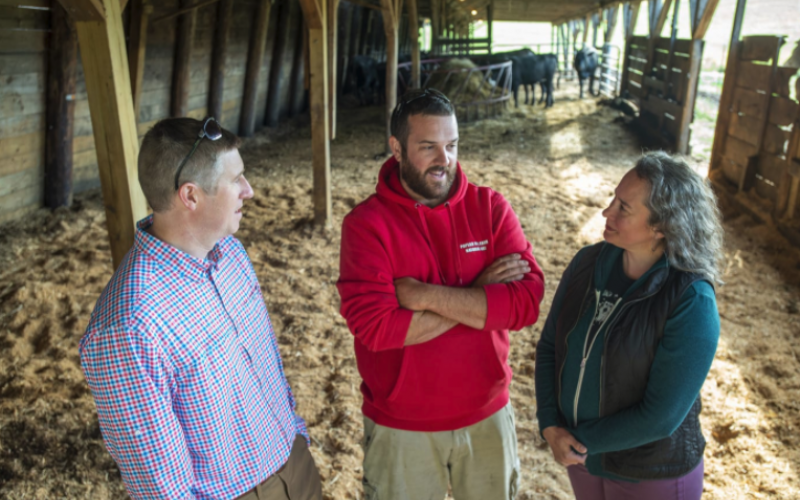
Andy and Mike Mahar of Poplar Hill Farm both shared that collaborating with other stakeholders is key. In the example above, Smith College was able to leverage the collective purchasing power of multiple institutions to purchase whole animals and process them at a reduced cost. Mike shared that working with other farmers who are already involved with institutions is key to his success. Poplar Hill Farm works with several small farms in the surrounding area that may not have the infrastructure or volume to work directly with institutions.
“We buy animals from them, almost like a satellite operation. I get paid by the institution and I spread the money around,” says Mike.
“Numbers make a difference,” adds Tina, “If there is a group of producers that approach an institution and say ‘we think our products give your dining hall value... and we want to sell to you’ that can send a clear message.”
Go Beyond the Low-Hanging Fruit
Andy shared that once Smith College was spending about 9% of its budget on local food, they had to start looking beyond dairy, apples, and local greens in order to keep making progress. The growing season in the Northeast can make consistent local purchasing a challenge, so one strategy that Andy adopted is to look for local products that are available year-round, like meat and mushrooms. He also recommends increasing the volume of certain products in order to gain negotiating power. For example, he doubled the number of shiitakes he purchases in order to get local mushrooms at a lower price. Farmers may wish to consider the value of year-round and/or volume purchases in their negotiations with institutional buyers.
Be Strategic With Food Service Management Companies
For farmers and distributors who are interested in working with institutions, it's important to understand their operating structure as well as their commitments to values-based food procurement. Dining services that are self-operated often have more flexibility in how and from whom they can make purchases. Those managed by food service management companies (FSMCs) often have stricter requirements regarding the use of preferred vendors, including a percentage of purchases that need to come from them. There are a number of barriers farmers (especially small farmers) face in becoming preferred vendors. For institutions, working with a local distributor who already has approved vendor status is one strategy for working with small farms in your area. If there is a specific farm that your institution is interested in working with, consider bringing those farms to your approved distributor and asking them to carry their products. For small farms, consider working with your local specialty distributors to access those institutional markets.
“We’ve been able to use language within contracts in order to serve institutions when they couldn’t get a product through preferred vendors,” says Nick of Marty’s Local.
Tina points out that FSMCs might also have programs to incentivize purchasing from local producers.
These are just a few of the strategies discussed in our panel; we hope you’ll check out the full recording for more detail. We are grateful to NOFA for this opportunity and we look forward to collaborating more in the future!
Additional resources
Email Panelists
- Tina White: tina@realfoodchallenge.org
- Andy Cox: acox@smith.edu
- Nick Martinelli: nick@martyslocal.com
- Mike Mahar: poplarhillfarminc@gmail.com
Email FINE moderators
- Hannah Leighton: hannah@farmtoinstitution.org
- Tania Taranovski: tania@farmtoinstitution.org